l The Origin of Non-Use Cancellation System
China's three-year non-use cancellation system for registered trademarks (abbreviated as "non-use cancellation") originated from the legislative purpose of the Trademark Law. It was first included in the 1993 Trademark Law. Its purpose is to clean up idle registered marks, prevent trademark hoarding and malicious registration, and promote the real use of trademarks. Therefore, the non-use cancellation procedure has been widely adopted in China's trademark affairs in recent years.
l Changes In The Initial Burden of Proof for Non-use Cancellation Applicants
Since the legislative purpose of the withdrawal system is to clean up idle registered trademarks and maliciously hoarded trademarks, the China National Intelltucal Property Administration (“CNIPA”) has always had a relatively light proof requirement for non-use applicants: they only need to provide preliminary evidence to prove that there is reasonable doubt that the applied trademark is not in use. However, in recent years, the number of no-usel applications has increased year by year, and even appeared to be rampant. On the one hand, in order to cope with the growing number of rejected applications, the right holders have widely adopted the non-use procedure as a way to remove registration barriers. On the other hand, some applicants (not excluding malicious competitors) have filed non-use applications for the same registered trademark several times in succession in order to create obstacles to the use of trademarks for companies that are legally registered, truly used, and operated in good faith, and disrupt normal operations, resulting in a sudden increase in the cost of trademark registrants to maintain trademark registration and use trademarks, seriously affecting the normal operation of companies.
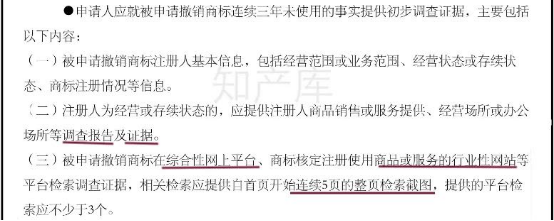
In view of the serious challenge to the original intention of the non-use system, in order to balance the interests of all parties and avoid the proliferation of malicious non-use applications and the disruption of the order of trademark registration management, we have observed that the CNIPA has recently issued a large number of notices of correction of non-use applications, requiring the applicants to submit preliminary evidence to prove that the applied trademark has not been truly and effectively put into commercial use. The current notice requires the following preliminary evidence: 1. Basic information of the applicant, including business scope, business status or existence status, trademark registration status and other information; 2. If the applicant is in business or existence, it should provide investigation reports and evidence such as the sales of goods or services provided by the applicant, business premises or office premises; 3. Search and investigation evidence of the trademark applied for cancellation on comprehensive online platforms, industry websites for goods or services approved for registration and use of trademarks, etc. The relevant search should provide full-page screenshots of 5 consecutive pages starting from the homepage, and the platform search provided should be no less than 3.
This move by CNIPA will inevitably increase the burden of proof for applicants who wish to non-use others’ mark. How should non-use applicants and trademark agencies respond? Will the CNIPA further issue explanations to further refine and clarify the matter? We will wait and see.
l Tengyu Uses Intelligent Monitoring System to Quickly Complete the Initial Burden of Proof
In response to the above-mentioned correction notice from CNIPA, in the absence of further clarification on the details and the platforms include, Tengyu uses the intelligent monitoring system to reach various comprehensive network platforms, including but not limited to Baidu, Sohu.com, NetEase, Xinliang Weibo, Bing, JD.com, Tmall, Taobao, Pinduoduo, etc., as well as offline physical stores, companies, and shops across the country. Through this channel, Tengyu can quickly obtain information, and only needs to screen the information to obtain relevant online evidence. In addition, for offline evidence, Tengyu also uses the online identification + offline visit model to complete the initial burden of proof.

In the context of the adjustment of the trademark non-use application rules, applicants are required to submit systematic and quantified evidence to prove non-use. The above monitoring system enables Tengyu to easily assist customers in collecting online evidence, conducting field investigations, obtaining registrant qualification certificates and generating systematic analysis reports. This method can help non-use applicants to complete the initial burden of proof quickly, comprehensively and cost-effectively. Under the new circumstances, the intelligent monitoring system has become an important helper for Tengyu’s clients to safeguard their own rights and interests and make reasonable use of trademark resources.
l Tengyu's internal investigation team further assisted in the withdrawal of the three
In response to the new requirement of CNIPA for the submission of "investigation reports and evidence of business premises and office premises" for non-use cancellation application, if the aforementioned intelligent monitoring system is unable to provide relevant evidence, Tengyu's internal investigation team can also be activated in a timely manner to provide high-quality and cost-effective on-site investigation and evidence collection services, further helping customers cope with the strict requirements for non-use cancellation application.